All posts by Krishna Naraayan

Hollywood: A Capitalist Machine?

There is something slightly strange about the way Hollywood makes films today. We have reached a point where studios can analyse audience preferences, track streaming habits and use predictive algorithms to estimate which stories are most likely to succeed, sometimes before a camera has even been switched on. On paper, this sounds like progress. Why spend millions on a film nobody wants to watch when data can help identify what audiences enjoy? Yet I wonder whether, in our eagerness to understand what people want, we have become a little too comfortable giving them what they already know.

The endless sequels, familiar franchises and recycled storylines are not exactly new, but the technology behind filmmaking has made predicting audience behaviour increasingly sophisticated. Machine-learning models identify patterns in historical data, helping studios assess which genres, actors and narrative structures might generate returns. The problem is that recognising a successful pattern is not the same as understanding why it succeeded. When commercial decisions become too dependent on historical performance, experimentation begins to look like an unnecessary risk. Hollywood starts behaving less like a creative industry and more like an algorithm optimising for predictable outcomes.

Perhaps the most interesting way to understand this is through the concept of a feedback loop. Recommendation systems use our viewing history to suggest films we might enjoy, and our subsequent choices provide more data for future recommendations. This is not inherently harmful, but it can reinforce existing preferences at the expense of discovery. The Truman Show offers an interesting parallel: Truman’s carefully constructed world is designed around predictable behaviour, leaving little room for experiences beyond its boundaries. Real algorithms are hardly Truman’s producers, but the comparison raises an important question about how much our environments influence what we come to expect.

Yet some of cinema’s most memorable experiences emerge precisely from uncertainty. Before watching Inception, we might never have imagined that a complex narrative about dreams could become such an engaging cinematic experience. Its layered storytelling challenges audiences rather than simply reproducing familiar formulas. This illustrates a fundamental distinction in computer science: exploitation involves using what is already known to work, while exploration involves testing possibilities whose value remains uncertain. An industry that prioritises the former indefinitely risks overlooking the latter.

There is also a deeper problem with measuring success. Opening-weekend revenue, streaming completion rates and audience ratings are useful metrics, but they remain proxies for something far more complicated. Interstellar, for instance, offers spectacular science fiction while exploring time, grief and human connection. A model can measure engagement with a film, but those measurements cannot fully explain why its ideas might remain with someone for years. The issue is not that human responses cannot be studied; it is that no single metric can adequately represent artistic value.

I understand the logic. Studios have employees, investors and financial risks to consider, and data can help unconventional films find their audiences. But there is a difference between using technology to inform creative decisions and allowing measurable outcomes to determine the boundaries of imagination. Perhaps cinema’s greatest strength lies in its ability to change our preferences rather than merely satisfy them. The real danger is not that computers will eventually become capable of predicting what we want to watch, but that we might become so dependent on their predictions that we stop discovering what we never knew we wanted.

Strategizing and Collabrating: Mr. Shekhar Sharma on gaming

Gaming is often seen as a distraction from learning, yet it involves strategy, collaboration and problem-solving. Do you think gaming is overlooked as a space where students can develop skills that classrooms may not always nurture?

Gaming is often seen as just a distraction, yet it builds skills that classrooms oftentimes overlook. Strategy games demand quick thinking, planning, and risk management under pressure. Online multiplayers need communication, leadership, and collaborative problem-solving, teaching players to work well within teams to achieve their objectives. Unlike normal learning environments where failure often carries punishment, gaming normalizes trial and error. It trains people to find their mistakes, refine strategies, and keep pushing through setbacks. This builds a resilient, growth-oriented mindset. By gamifying challenges, gaming transforms instruction into active learning, developing crucial real-world skills perfect for the modern workforce.

Students and Teachers: Ms. Sarika Kaushal on the importance of a connect

Having been recognized for your teaching methods, what do you think is the key stepping stone in making a connection between students and teachers?

I believe the key stepping stone in building a strong connection between students and teachers is trust, patience and understanding. Teaching is not just about sharing knowledge it is about creating a surrounding where students feel heard, valued and gets encouraged to express themselves without any fear of being judged. A teacher should connect with  each and every student individually and understand them on a personal level and make them comfortable enough to be themselves, because ultimately students learn best from their teachers and when they know that the teacher has faith in them and believes in their potential and is always there to guide and support them both academically and personally.

Technology and Distractions: Mr. Mohitendra Dey on retaining focus

Technology devices offer enormous educational value but also constant distraction. What is one thing that students should keep in mind to maximize the best of both worlds?

Ans) Students should remember that a device is only as useful as the intention behind each tap. Before opening any screen, ask a simple question: “What am I here to do?” If the answer is to research, write, or learn, stay on that task and close everything else. The same tablet that delivers world-class lectures also holds games and endless feeds, and the difference lies in who is steering. Treat attention as a limited resource worth protecting. Silence notifications, set a clear goal for each session, and take real breaks away from the screen. When purpose guides use, technology becomes a powerful tutor rather than a tempting distraction, and learning gets the best of both worlds.

Learning to Lead: Mr. Anil Kathuria on Responsibility

As a teacher who has watched students take on these responsibilities, what changes do you see in them when they’re accountable for an event with real stakes, and how do you decide when to step in and when to let them figure it out on their own?

Over the years, I have seen a gradual change in the nature of responsibilities handled by students. Earlier, these used to be restricted to department-specific work like Design, Quizzing, Sudocrypt, etc., but today, students handle almost everything – from sponsorship and administrative work to printing and even ushering.

This has broadened the way students work and handle responsibility. As their horizons widen, they learn not only about the world, but also about themselves – their strengths, limitations, and ability to take ownership.

As a teacher, it also teaches us when to step back and let them figure things out – when to fail, learn from their mistakes, and grow – and when to step in and guide them. As the saying goes, “Teachers can open the door, but you must walk through it yourself.”

From Learning to Building: Mr. Naresh Miglani on the Evolution of School Clubs

With technology evolving so quickly, how do you see the role of school clubs changing from platforms for learning and collaboration to spaces where students can actually build and implement their ideas, and what do you think makes that transition possible?

Ans) Having taught Mathematics for over 35 years and now serving as a Vice Principal, I believe school clubs must evolve from being merely platforms for learning and collaboration into launchpads for innovation, experimentation, and real-world problem-solving.

    In a rapidly changing technological world, students should not just learn about technology; they should use it to identify problems, develop solutions, build prototypes, and create something meaningful. Whether it is a Mathematics Club, Robotics Club, Coding Club, or a Computer Club (like Exun in our school), every club should encourage students to move from “What can I learn?” to “What can I create?”

    This transition becomes possible when schools provide three essentials: freedom to explore, guidance from mentors, and opportunities to implement ideas. Students must be encouraged to experiment, collaborate across disciplines, learn from failures, and refine their solutions.

    Technology provides the tools, but curiosity provides the spark, and perseverance turns ideas into reality.

    The true success of a school club is not measured by the activities it conducts, but by the ideas it inspires and the impact its students create.

    Teaching the Art of Problem-Solving : Mr. Mukesh Kumar

    Coding is often taught as a rulebook, but many programmers say the real skill is breaking a big problem down into smaller steps. If you had to teach one, what would it be, to code or make them think like a coder? How would you teach them to tackle problems?

    Ans) Don’t Just Teach Children to Code. Teach Them to Think Like Coders.
    Having taught Computer Science and trained teachers for 36 years, I firmly believe that logic, reasoning, and problem-solving are abilities that exist within a child from birth. Our responsibility as educators is not to create these abilities, but to nurture and help them to use these to solve problems..

    Long before children encounter a computer, they recognise patterns, understand cause and effect, make choices, and find ways to overcome everyday challenges. Coding simply provides them with another language to express their thinking.

    If I had to choose between teaching children how to code and teaching them how to think like coders, I would choose the latter without hesitation. Programming languages may change, technologies may become obsolete, and AI may generate code, but logical thinking and problem-solving will always remain valuable.

    Start with problems, not programming languages –
     Ask children how they would organise their school day, plan a journey, or prepare for an unexpected situation. Such activities naturally introduce sequencing, decision-making, and logical reasoning.

    Teach them to break big problems into smaller units.
    A complex task becomes manageable when divided into simple, solvable steps. This is the essence of computational thinking.

    Encourage them to ask “Why?” and “What if? – Questions develop curiosity, challenge assumptions, and help children anticipate different possibilities.
    Let them make mistakes.  An error is not a failure; it is feedback. Instead of immediately correcting a child’s code, ask what they expected, what actually happened, and how they can identify the difference. This builds resilience, confidence, and independent thinking.

    In the era of AI, the teacher’s role becomes even more important: to help children evaluate solutions rather than blindly accept answers.

    After 36 years in education, my conviction remains unchanged: When you teach a child to code, you teach a skill, which helps  a child to think like a coder, and you equip them to solve problems for life.


    We, Not I, the belief that you have instilled in us says that a  team achieves more than its most talented individual. Can you tell us about a time when a brilliant individual, who depicted this very idea in some instance by exhibiting teamwork?

    Ans) Every day at Exun is a living testament to the power of collaboration, where mentors and members inspire one another to grow, create, and achieve together. At the heart of this journey lies the club’s timeless motto, “We, Not I”—a powerful reminder that true success is not about individual achievements alone, but about the collective strength, shared learning, and lasting bonds that make a team extraordinary.

    Microprocessor Architectures

    What are Microprocessor Architectures?
    A Microprocessor Architecture is a definition of the way in which the internal components
    of a processor are organised and interact to execute functions and instructions. They can
    be classified by instruction sets, complexity, design philosophy, performance aims, power,
    speed balance, etc.
    Arithmetic Logic Unit, Central Unit and registers are key factors for math & logic
    operations, instruction flow management and temporary data storage respectively. They
    are connected to memory and I/O devices by data, control and address.
    The architectures are broadly split into the CISC and RISC architectures.
    The Performance Equation

    The given image shows the equation used for expressing a computer’s performance.
    The CISC architectural approach minimizes the instructions per program even though it
    may lead to more cycles per instruction
    Meanwhile, the RISC architectural approach reduces the cycles per instruction, sacrificing
    the number of instructions per program.


    CISC Architecture

    What is it?
    CISC or Complex Instruction Set Computing is an architecture wherein multiple commands
    are executed within a single instruction set with a variable size, minimizing the command
    count per program and thus reducing the amount of code required.


    History
    CISC architecture emerged in the 1950s, the early computer era, wherein, memory was
    expensive. This architecture allowed minimization of code size and usage of a single
    instruction set to execute multiple complex commands, easing programming without
    advanced compilers and saving on memory.
    IBM, led by Gene Amdahl, pioneered it with the System/360 mainframe from 1964.
    In 1978, Intel further advanced CISC for PCs with the 8086 microprocessor.
    The modern x86 Intel and AMD Ryzen processors translate CISC instructions to RISC
    micro-ops for efficiency.

    Uses
    It eased programming, especially in Assembly.
    Executing multiple, complex commands, combining data structures and array accesses in
    one instruction set, saving memory with smaller program sizes. This is possible as the
    architecture directly supports high-level programming constructs like loop control,
    addressing modes and procedure calls.
    It continues to be the standard architecture in Intel x86 and AMD Ryzen desktops, laptops
    and servers. The backward compatibility in softwares prevents full switch to RISC
    architecture.
    Complex instructions are broken down into subroutines known as microcode


    Characteristics
    ● Complex instructions and complex instruction decoding
    ● Instruction sets have a variable size
    ● Instructions can take more than a single clock cycle for execution
    ● It has numerous complex address modes

    ● Operations get performed in memory so fewer general-purpose registers in the
    chips.
    ● Supports complex ops in one command.
    ● Single instructions can perform multiple low level instructions

    Implementation | The CISC Approach
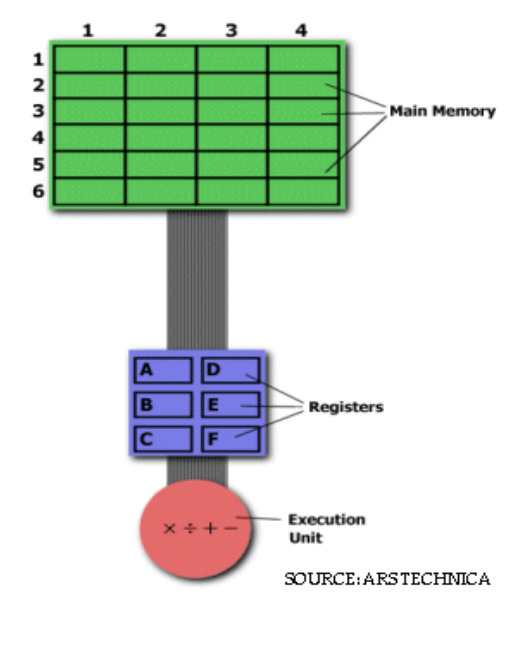
    Taking the image given below for reference. While in standard microprocessor literature chips use hexadecimal linear addresses like 32-bit or 64-bit addresses, let’s say that the main memory contains data from (in row:column format) 1:1 to 6:4. Now, if we want to multiply, for example, the value in 3:1 with the value in 5:4 and input the product in 3:1 to replace the previous value.

    To solve this through basic assembly, we would firstly need a hardware processor capable of understanding and executing a series of required operations. Such a processor would likely be prepared with a specific instruction for multiplication, typically MUL. On execution, the instruction would load the integers into two separate registers, multiplies the ops in the execution unit and stores the output in the apt register. This entire task can be completed with a simple instruction MUL 3:1, 5:4 Here, MUL is a complex instruction. Here, it isn’t required to
    specifically call a loading or storing function. Alternatively, we can use a higher level
    language wherein, we can take 3:1 as a and 5:4 as b and use * for multiplication. In this
    way, the command identical to the instruction would be- a = a*b In both cases, the
    instruction is short and hence easier to translate to binary
    Advantages
    ● A single instruction can perform multiple low-level operations
    ● The multiple address modes enhance flexibility
    ● The code for instructions is shorter, easing programming.
    ● Since the instructions are smaller, the compiler has less to translate and very less RAM is required for storage.
    Disadvantages
    ● The microprocessors require more power due to variable instruction set sizes
    ● They require more transistors, increasing cost and heat
    ● Complex decoding leads to slowed execution and multiple clock cycles.
    ● CISC processors need to be bigger and hence may not be suitable for smaller devices

      RISC Architecture


      What is it?
      RISC or Reduced Instruction Set Computer is a microprocessor design focusing on small,
      optimized instruction sets that would be executed in a single clock cycle.


      History
      The RISC architecture concept emerged in the 1960s with Seymour Cray’s CDC 6600
      implementing load-store architecture. However formal development of the RISC
      architecture began in 1975 led by IBM’s John Cocke in the 801 project, eventually
      prototyping the first RISC architecture for faster telecom switching in 1980.
      Through the 1980s, RISC advanced commercially.
      In the 1990s, it expanded with PowerPC and dominated the embedded systems.
      A major setback for IBM’s RISC architecture chips was Intel with their CISC processors even
      though they were losing popularity, Intel possessed resources for thorough development
      and production of powerful processors
      Now, in 2026, RISC-V is open source and gains traction in IoT and AI.


      Examples
      ● ARM, a.k.a the Advanced RISC Machine- It is globally the most widely used RISC
      architecture. It powers IoT devices, smartphones, tablets, the Apple M-series
      Macbooks, etc.
      ● RISC-V- It is an open source instruction set architecture that enables companies to
      design custom chips without needing to pay licensing fees. It’s gaining significant
      traction in IoT, AI acceleration and embedded systems.
      ● IBM Power a.k.a PowerPC- It has a historical significance in Apple Macintosh
      computers and iconic gaming consoles like Xbox 360, Wii, Playstation 3. Even now,
      it is essential in various IBM supercomputers and servers.
      ● Atmel AVR- It’s a prominent 8-bit architecture found in microcontrollers like
      Arduino
      ● MIPS- It’s one of the earliest commercial architectures. It previously powered
      Nintendo 64 and Playstation 1. While it’s not as prominent in current PCs, it can
      still be found in industrial controllers and networking equipment like routers.
      ● SPARC- It was developed by Oracle and used in Unix workstations and
      high-performance servers
      ● DEC Alpha- It was used in supercomputers and high-end workstations in 1990s,
      famous for its extreme performance until it was discontinued due to high
      manufacturing costs, corporate acquisitions, etc.
      ● Microchip PIC- It’s widely used in automotive systems and embedded controllers.

      Uses
      The modern x86 Intel and AMD Ryzen processors translate CISC instructions to RISC
      micro-ops for efficiency
      RISC-V allows companies to modify chips without any licensing fees, becoming a major
      focal point.
      They use multiple, longer but simpler instructions which include separate instructions for
      load and store to execute a command in a single clock cycle.
      It powers nearly all modern smartphones and tablets using ARM architecture. It’s
      responsible for handling apps, graphics and AI processing efficiently.
      It’s ideal for microcontrollers where low power and customization are required.


      Characteristics
      It has constant length, simple instructions.
      It uses load/store only operations to move data to/from memory from registers where the
      operation occurs.
      It has many registers to minimize memory access
      It uses pipelining to divide instructions into distinct stages to overlap the execution of
      multiple commands so that the instruction is completed in a single clock cycle. Pipelining
      helps in a uniform, fixed instruction size and simplicity.
      They are smaller

      Implementation | The RISC Approach
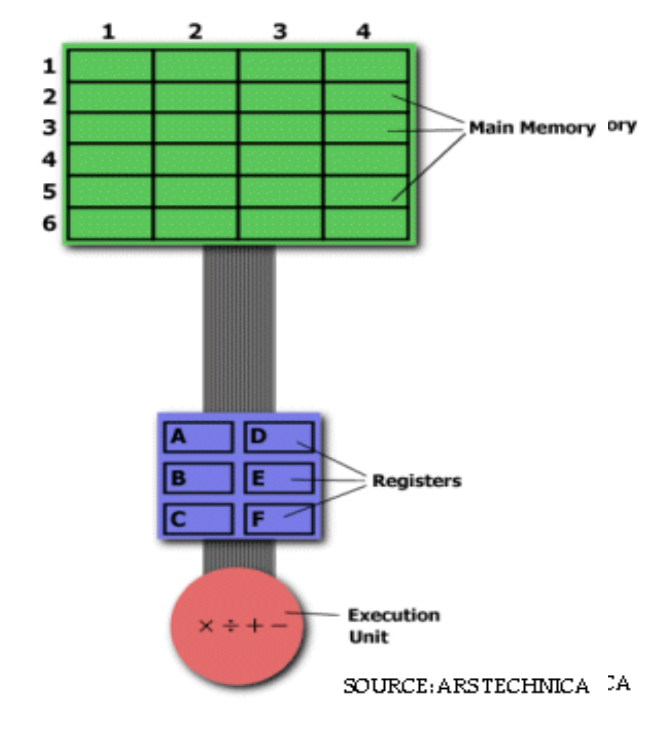
      Taking the image given below for reference. While in standard microprocessor literature chips use hexadecimal linear addresses like 32-bit or 64-bit addresses, let’s say that
      the main memory contains data from (in row:column format) 1:1 to 6:4. Now, if we want to multiply, for example, the value in 3:1 with the value in 5:4 and input the product in
      3:1 to replace the previous value. To solve this using basic assembly, we will have to first load
      the values individually onto the register using the LOAD function. We would give the values a variable to define them. Once the values are loaded, we can proceed to multiply them using the MUL function. By default, the output would replace the first value in the register which we need then to store it back in the memory and we would do this using the STORE function. Hence, we would require 3 commands to get our desired request

      LOAD A, 3:1
      LOAD B, 5:4
      MUL A, B
      STORE 3:1, A

      While there are more lines of code, this makes the instruction simpler for the RAM and
      compiler.
      Advantages
      ● Simpler hardware helps in easier pipelining and hence a faster execution time
      ● Higher clock speeds. Instructions are executed in a single clock cycle.
      ● It requires lower power as the instructions are simpler, there are lesser transistors
      and a simpler design
      ● It enables chips to be smaller, battery optimized and results in less heating
      ● It helps in better compiler optimization and scalability
      Disadvantages
      ● The programs are longer and hence require more memory for storage
      ● To perform a complex operation, you require multiple small, simple, typically
      one-worded instructions and so the capabilities of the architecture are limited
      ● RISC microprocessors are often more expensive

      -Saanvi Verma

      Unified Extensible Firmware Interface

      What is UEFI?

      UEFI (Unified Extensible Firmware Interface),a type of a software program that connects the program embedded in a computer to its operating system, has begun replacing the classic BIOS in most computers now. 

      What is BIOS?

      BIOS (Basic Input/Output System) is a program stored in a part of the Motherboard in the hardware of every computer which sets up essential components in the settings like keyboard language, date and time and then hands the reins to the OS. 

      How is UEFI a more flexible and adaptable way to run a computer?

      Nowadays, UEFI is preferred in computers as BIOS is limited to handling Hard Driver only of 2TB or less while UEFI can handle larger spaces as well. UEFI is also faster and more efficient than the BIOS. It is also considered to be safer than the BIOS. 

      Moreover, UEFI can function on various platforms and can be written in any programming language whilst BIOS being specific to IBM PCs and being written in Assembly Language. However, even though UEFI can be written in any programming language, it is most commonly written in a way referred to as TianoCore EDKII which is written in C Language. Therefore, UEFI is a more flexible and adaptable way to run a computer as compared to BIOS.

      History

      In the mid 1990s started the development of the first Intel-HP Itanium Systems with BIOS as the program embedded in the Motherboard. Itanium targeted larger server programs however, the BIOS limitations were too restrictive. The progressive effort to bring this concern into the spotlight began in 1998 by the name Intel Boot Initiative which was later renamed as EFI or Extensible Firmware Interface. 

      Eventually, after a long wait, in 2004, the first UEFI was released as an open source implementation and was called Tiano. 

      However, in 2005, Intel ceased the development of the EFI at version 1.10 itself. It began contributing to the Unified EFI Forum which, overtime has been known as Unified Extensible Firmware Interface. The original EFI specification remains owned by Intel, which exclusively provides licenses for EFI-based products, but the UEFI specification is owned by the UEFI Forum.

      On 31 January 2006, Version 2.0 was released which included cryptography and security. \

      Version 2.1 released on 7 January 2007 added network authentication and the user interface architecture (‘Human Interface Infrastructure’ in UEFI).

      In December 2018, Microsoft announced Project Mu, a fork of TianoCore EDK2 used in Microsoft Surface and Hyper-V products. The project promotes the idea of Firmware as a Service.

      The latest UEFI specification, version 2.10, was published in August 2022.

      Advantages

      • Unlike BIOS, UEFI can handle partitions larger than 2TB using it’s GUID Partition Table.
      • UEFI offers network access, GUI (Graphical User Interface), multi-language support.
      • It supports 32-bit and 64-bit systems
      • Within the UEFI environment, the C and Python languages are supported.
      • It has a modular design.
      • It is open to backwards and forward compatibility.

      Compatibility

      • Backward Compatibility

      UEFI is designed using the CSM (Compatibility Support Module) such that it can work with the BIOS-based operating systems and hardware components. The CSM is used to make the UEFI information accessible to the BIOS systems.

      • Forward Compatibility

      UEFI is designed to adapt to future advancements without affecting the core functionality, ensuring that it remains functional making it a platform which can be used by multiple generations, able to leverage the new technologies. 

      -Saanvi Verma

      ARPANET: The Invention that became a Global Phenomenon

      “The internet is becoming the town square for the global village of tomorrow.” 

      – Bill Gates

      ARPANET, also known as the Advanced Research Projects Agency Network, was an experimental  computer networking project by the United States Department of Defense, introduced in 1969, led by Bob Taylor and built by the consulting firm of Bolt, Beranek and Newman. It was initially designed to allow communication between research institutions and government agencies and during the cold war, provide the military with a mode of communication with a decentralized network architecture which could withstand nuclear attacks and destruction, keeping them ahead of their opponents. At first, there were only four nodes of the network, University of California-Los Angeles, Stanford Research Institute, the University of California-Santa Barbara and the University of Utah. However, as it grew to build academic, military and research-institutional connections such that by 1973 it had connected two international sites, the University College of London in England and the Royal Radar Establishment in Norway and already 37 connected locations in the United States including a satellite link from California to Hawaii and established communication links soon after, it became the precursor of the modern internet as its key features like operational packet-switching networks and wide-area range laid the foundation for something much bigger. The ARPANET worked by grouping data into short messages which were transmitted over a digital network through interface message processors.

      The first meaningful message sent over the ARPANET was intended to be the word “login” however, after transmitting the letters “l” and “o”, the system crashed therefore making the historic message only “lo”, short for “login”. 

      Moreover, ARPANET also contributed to the innovation of technologies like email, FTP, Telnet, DNS, etc. and protocols including TCP/IP (transmission control protocol/internet protocol) in 1983 after which ARPANET was divided into military and civilian and the term ‘internet’ was first used to describe a combination of networks which later pitched in in the replacement of ARPANET. However, similar to most early technologies, the network faced some challenges and limitations which included but were not limited to scaling the network for the ever growing population of users and increasing demand for bandwidth & ensuring interoperability between different computer systems and networks. Despite these challenges, ARPANET kept evolving as it included more and more universities, research institutions and government entities and with the addition of more nodes, it grew in terms of complexity and size. 

      The legacy of the ARPANET is evidently immense. Although it was initially developed in the United States, it had a global impact as it later expanded to make connecting computers around the globe possible. It laid the foundation for the internet which is now a major part of modern society. It has revolutionized the way we communicate, work, research, and operate business. It has paved the way for numerous technological advancements which have made the world today fast paced and digital. While it focused on communication and networking infrastructure it played a vital role in the formation of the world wide web. The ARPANET was shut down in 1989 and formally decommissioned in 1990 because other networks became more dominant but the groundbreaking innovation and the shift from an academic and research centered network to an international information superhighway shaped the way we live as a whole.

      -Saanvi Verma